
Why Roswell gutters need repairs
A few things about homes in and around Roswell make certain problems more common:
- Aging subdivision gutters. A large share of the city was built out between the 1970s and 1990s, so many homes have original or second-generation gutters whose fasteners have been through decades of heat and cold.
- Mature trees over the roof. Heavy canopy means heavy, wet debris loads, and the occasional branch landing on a gutter during a storm.
- Sloped lots. On homes with a walkout basement, the back eave can sit three stories up. Problems there go unnoticed longer because nobody looks up at them, and they're harder to reach safely.
- Sudden, heavy rain. Summer storms test every seam and hanger at once, which is often when a weak spot first shows itself.
Problems a repair can usually solve
Gutters leaning or separating from the house
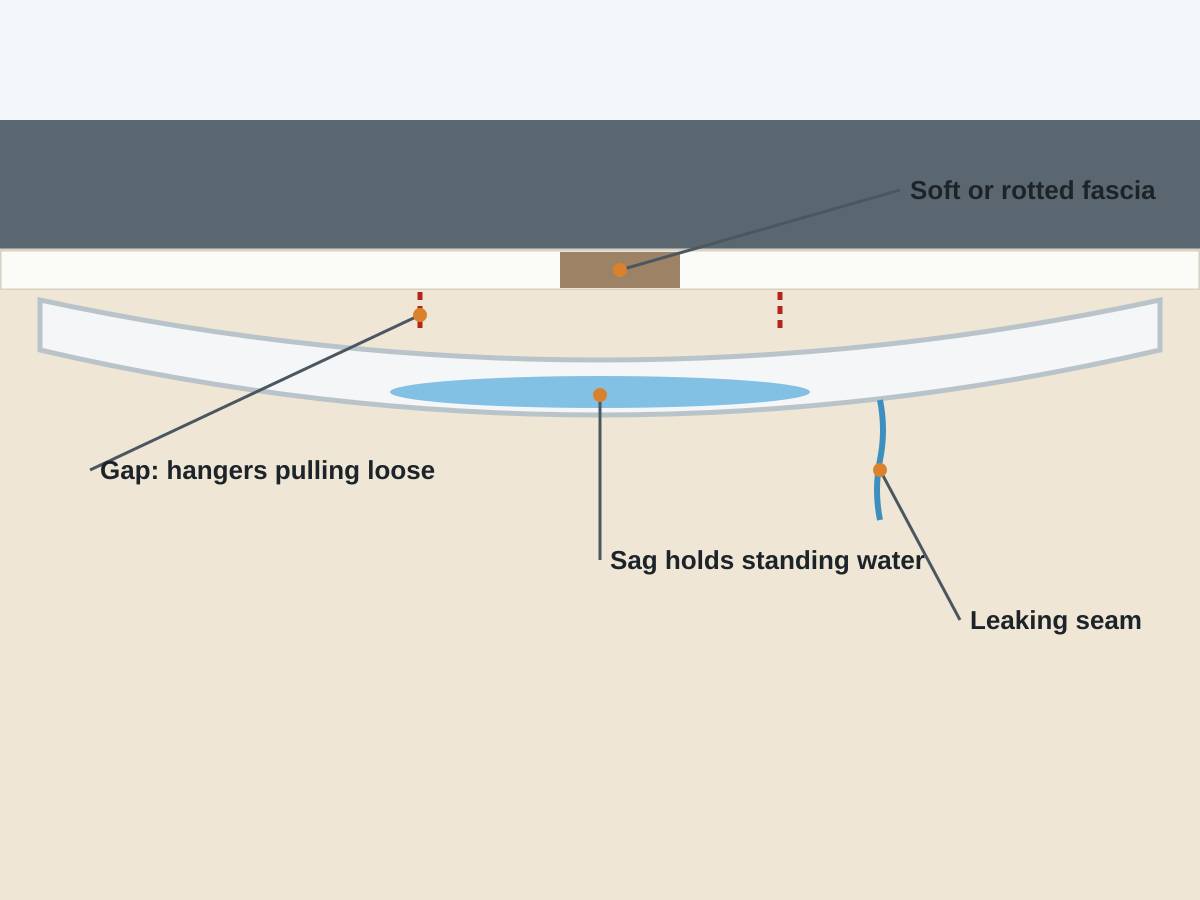
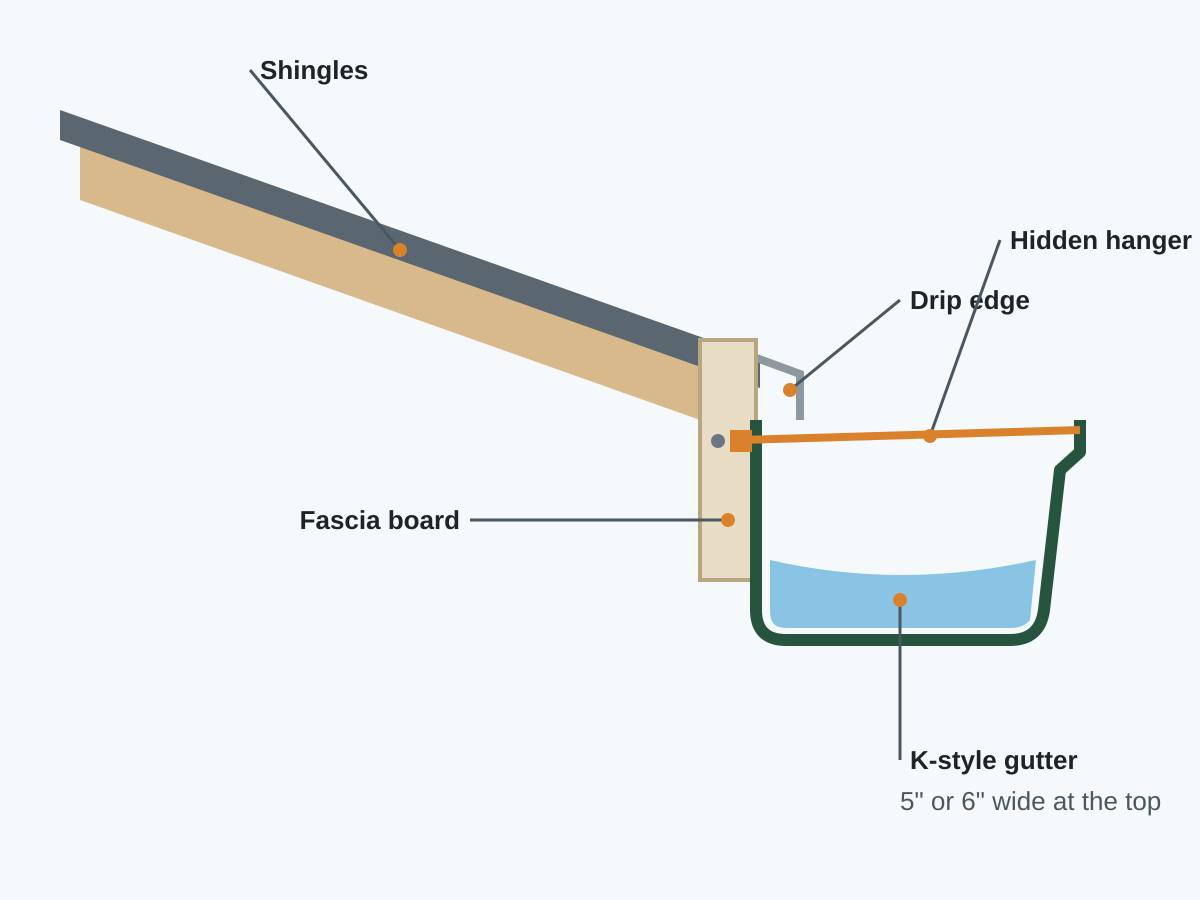
When you can see daylight between the gutter and the fascia, the fasteners have lost their grip. Older installations often used long spikes and ferrules, which work loose over the years. The typical fix is to swap them for hidden hangers screwed into solid wood, placed close enough together to carry a full load of water. If the wood behind has gone soft, it gets repaired first; otherwise new screws pull out just like the old spikes. Our article on gutters pulling away from the house goes deeper on causes.
Standing water and lost pitch
A gutter should fall gently toward its downspout. When a stretch flattens out or dips, water and fine grit sit in the low spot, adding weight that makes the dip worse. The repair is to loosen the run, reset its slope, and add support where it sagged. After a long-standing puddle, look closely at the low point for pinholes or corrosion.
Dripping corners, joints and end caps
Mitered corners and end caps are the usual leak points, even on seamless gutters. Sealant ages, cracks and lifts. A lasting reseal means scraping out the old material, drying the metal, and sealing from the inside of the gutter. A fresh bead smeared over wet, dirty sealant tends to fail by the next season.
Storm and limb damage
A falling branch can crush a section, snap hangers, or pull an outlet loose. Many of these are straightforward to patch or splice. Keep people and vehicles clear of a gutter that's hanging after a storm until someone has looked at it.
Loose outlets and downspout joints
When the outlet or an elbow separates, a whole run's worth of water falls straight down the siding and into the bed beside the foundation. Re-fastening is usually quick. If the downspout or a buried line is blocked, see downspout cleaning and repair.
Before the pro arrives
- Don't climb to a loose gutter. A detached section is heavy and can swing. On a two-story or walkout-side eave, leave it entirely to a professional.
- Watch it in the rain from the ground. Note where water spills, drips or runs behind. A phone video is a big help.
- Move water away from the house with a temporary extension if a downspout has come apart.
- Book an assessment before the next stretch of storms or the fall leaf drop.
How a repair visit usually goes
- Clean the affected runs so the pitch and seams can actually be judged.
- Check hangers, fascia, joints, outlets and slope along the whole run, not just the obvious spot.
- Show you what they found, ideally with photos, and agree on the price before any extra work.
- Make the repair: re-hang, re-slope, reseal or splice.
- Run water through it and confirm it reaches the downspout without dripping.
When repair stops making sense
Repair is the right call when the metal is sound and the problems are limited. It becomes poor value when:
- You're fixing the same runs every year
- Leaks and sags show up on most sides of the house
- The gutters overflow in ordinary storms even when they're clean, which suggests they're too small
- Large stretches of fascia need replacing, so the gutters have to come off anyway
In those cases, compare the numbers on seamless gutter replacement.
What drives the price of a repair
- The fix itself: a resealed corner is minor; re-hanging a long run is a bigger job
- Where it is: a single-story front eave is easier than the downhill side of a walkout
- What's behind the gutter: soft fascia has to be dealt with first
- Matching parts: finding the right profile and color for a splice
- Timing: bundling with a cleaning is often more efficient than a separate trip
The cost guide explains these factors in more detail. For a free estimate on your home, call (678) 820‑6633.
What to ask the professional
- What's actually causing this, and can I see photos?
- Is the wood behind the gutter solid enough to hold new fasteners?
- What hangers will you use, and at what spacing?
- Will you check the other runs while you're up there?
- Do you think this repair will hold, or would you replace this section?
- What liability coverage do you carry for work at this height? (Ask for proof of anything you rely on.)
Get it looked at
Call soon if a gutter is hanging, water is spilling next to the foundation, or you can see stains and soft wood behind the gutter. High eaves, steep roofs and walkout elevations are jobs for a professional. Tell us what's going on and we'll connect you with an experienced, qualified local pro who serves Roswell.