
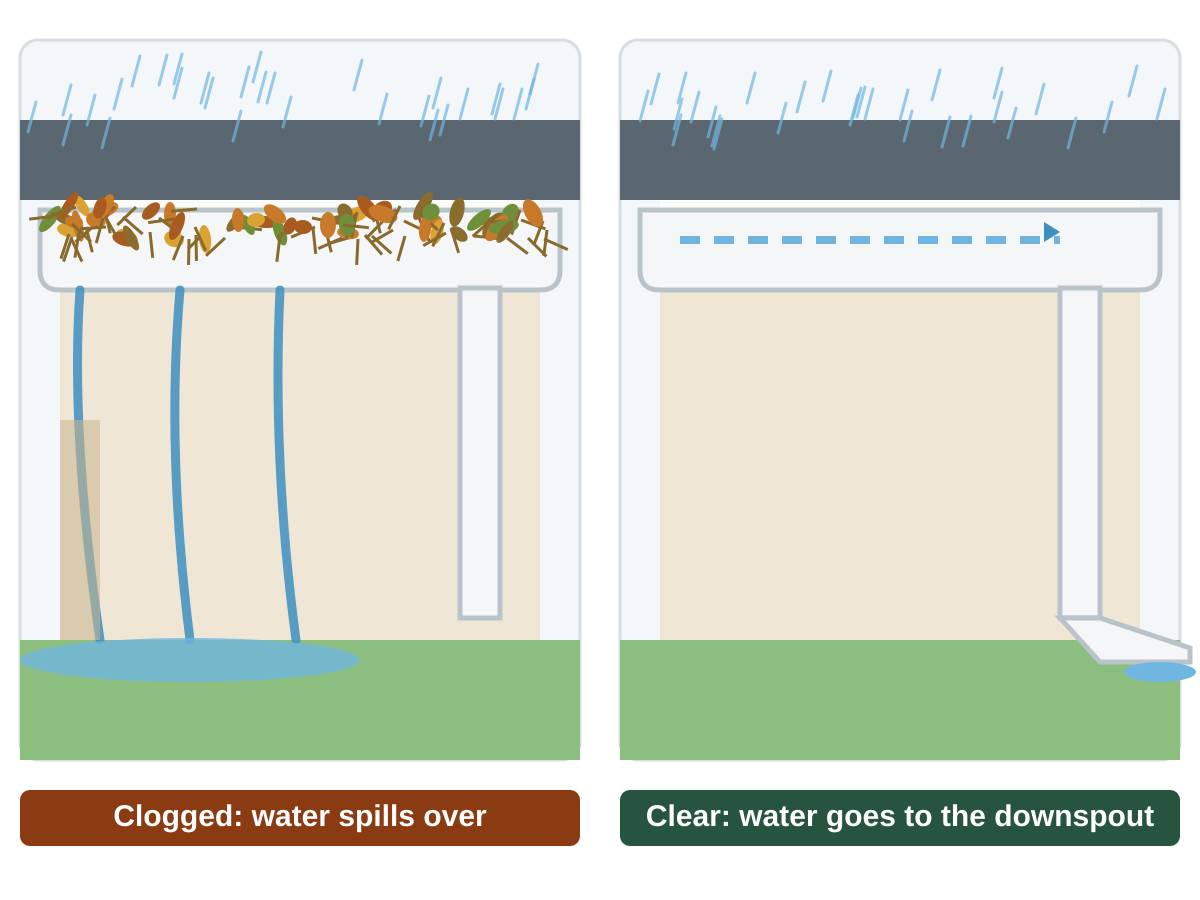
A gutter has one job: catch the water coming off the roof and hand it to a downspout that carries it away from the house. Overflow means something in that chain is stuck, too small or out of line. Before anyone books gutter cleaning in Roswell, GA or a repair, it helps to know which link has failed, because a cleaning won't fix a valley that overshoots, and new gutters won't fix a buried drain that's packed with silt.
Why it starts in October and November here
Fall is when most North Fulton homeowners first notice water coming over the edge. Tulip poplars start dropping in September, then oaks, maples and sweetgums follow from late October into December, and loblolly pines shed a heavy round of needles at the same time. Needles knit into a mat at the bottom of the trough, broad leaves land on top, and the first steady rain turns the lot into a dam. Sweetgum balls keep falling after the leaves are gone and tend to jam the downspout outlets just when the gutter looks clear.
Timing a single fall cleaning too early is a common reason gutters overflow again by Thanksgiving. Our month-by-month cleaning calendar for North Fulton shows which trees fill the gutters in which weeks, so you can plan visits around your own canopy.
First, take a rain walk
The quickest diagnosis is free and happens on the ground. During the next steady rain, take an umbrella and walk the whole house, including the back. On sloped lots in Roswell, Mountain Park and the hillier parts of Sandy Springs, the tall downhill side over a walkout basement is the one people forget to look at, and it's often where the trouble is.
- Where does the water come over: along a whole run, at one point, at a corner, or at an end?
- When does it happen: in every shower, or only in the hardest downpours?
- What are the downspouts doing at the bottom: running full, trickling, or dry?
- Is water dripping behind the gutter, between it and the trim?
- Where does the water go once it reaches the ground: away downhill, or back toward the foundation?
A thirty-second phone video of each problem spot is the most useful thing you can hand a professional.
Seven places gutters overflow, and what each one means
1. A sheet of water along the whole run
Usual cause: The gutter is full. In fall, that usually means wet oak, maple and tulip poplar leaves packed on top of a mat of pine needles, with seedlings or moss if it has been a while.
Usual fix: A full cleaning, then a schedule that matches your trees so it does not refill before the next storm.
2. A spill right above one downspout
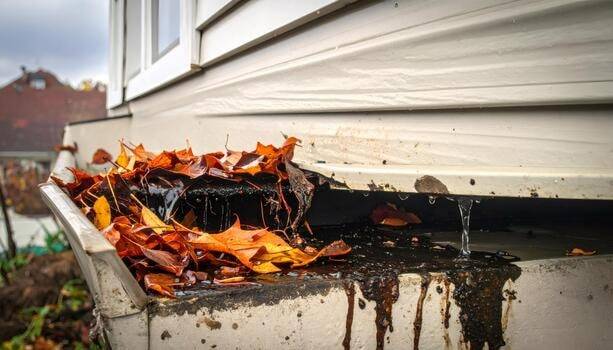
Usual cause: The gutter is draining into a blocked outlet. The first elbow at the top and the kick-out at the bottom are the usual choke points; sweetgum balls lodge there and leaves pack in behind. If the downspout runs into a pipe in the ground, the buried line may be the part that is blocked.
Usual fix: Clear the outlet and elbows, then test the downspout and any underground line with water.
Underground lines are common on sloped North Fulton lots, and they clog out of sight with shingle grit, seed pods and roots. If water bubbles up where the downspout meets the pipe, the blockage is in the ground. Our page on clearing clogged downspouts and buried drain lines covers how pros test and clear them.
3. Water jumping over an inside corner
Usual cause: Where two roof slopes meet in a valley, a whole section of roof drains into a narrow strip of gutter. On a steep roof the water arrives fast enough to shoot straight over the front edge.
Usual fix: A valley splash guard at the corner, a downspout moved closer to the valley, or a larger gutter on that run.
Valleys are everywhere on the two-story traditionals built across Roswell from the 1970s onward, and on the larger, more complicated rooflines common in newer Alpharetta neighborhoods, where dormers and stacked roof sections funnel water into a few inside corners.
4. Overflow at the end farthest from the downspout
Usual cause: The run has lost its fall toward the outlet, or it has sagged in the middle. Water sits in the low spot, grit settles there, and the run holds more weight every time it rains.
Usual fix: Re-hang the run at the correct slope with new hangers, and check the wood behind it.
Home inspectors use a simple benchmark here: InterNACHI's gutter and downspout inspection guide says gutters should fall toward the downspout at about 1/16 inch per foot, and that downspouts should carry water 4 to 6 feet away from the foundation. A run that has sagged below that line needs gutter repair in Roswell, usually new hidden hangers into solid wood and a reset slope.
5. Drips between the gutter and the house
Usual cause: Water is getting behind the gutter instead of into it: a missing or short drip edge, a gutter hung too far below the shingles, or a gutter that has started to tip outward as its fasteners loosen.
Usual fix: Add or extend the drip edge, reset the gutter tight under the roof edge, and repair soft fascia first.
6. A lower roof's gutter spilling over
Usual cause: Many two-story homes have an upstairs downspout that empties onto a porch, garage or sunroom roof. All that water hits one small patch of shingles and rushes into the lower gutter at a single point.
Usual fix: Extend the upper downspout down the lower roof into its gutter, add a diverter, or take the upper downspout to the ground.
7. Overflow only in the hardest storms, even when clean
Usual cause: The system is short on capacity: too much roof area draining to one outlet, a long run with a single downspout, small 2×3-inch downspouts, or 5-inch gutters on a big, steep roof.
Usual fix: Add a downspout, upsize the downspouts, or move that run to a larger seamless gutter.
Roswell storms make this one easy to spot. Afternoon thunderstorms can drop a lot of rain in a short time, and a big two-story roof sends it all down at once. If you see clean gutters spilling in those bursts, ask about adding outlets before anything else. When the gutters themselves are the bottleneck, seamless gutter replacement with larger 6-inch runs is the lasting answer.
Quick reference: from what you see to who you call
| Where it spills | Likely cause | Type of job | When it shows up |
|---|---|---|---|
| Whole run spills in an ordinary rain | Debris | Cleaning | Every season, worst in Nov and Dec |
| One spot right above a downspout | Blocked outlet, elbow or buried line | Downspout clearing | Fall and winter, as seed balls drop |
| Inside corner under a valley | Concentrated roof flow | Diverter or capacity fix | Heavy downpours |
| Far end of the run, or standing water | Lost slope or a sag | Repair | Any rain |
| Between the gutter and the trim | Drip edge or a gutter tipping out | Repair, often with fascia work | Any rain |
| Porch or garage roof below a second story | Upper downspout dumping on the lower roof | Reroute or extend | Any steady rain |
| Only in the hardest storms, when clean | Undersized gutters or downspouts | More or larger outlets, or bigger gutters | Summer storms |
Why overflow matters more on a hillside
On flat ground, an overflowing gutter mostly makes a mess of the flower beds. Here the terrain raises the stakes. North Fulton's clay-heavy soil takes water in slowly, so a roof's worth of rain dumped in one place tends to pool or run rather than soak away. On the uphill side of a walkout, it runs back toward the foundation; on the downhill side, it falls two or three stories straight down beside the basement wall.
The UGA Cooperative Extension's advice on leaky gutters and downspouts lists the damage plainly: water that the gutters fail to carry away can harm woodwork, siding and the foundation and lead to wet basements and crawl spaces, and gutters under a lot of trees may need cleaning more than once a year. Look for washed-out mulch, a trench under the drip line, peeling paint on the fascia, and damp walls or white mineral deposits on the same side of the basement as the spill.
Checking it safely
Most of this diagnosis needs no ladder at all. If you do want a closer look at a single-story eave on a dry day, follow the basics in OSHA's portable ladder safety QuickCard: set the ladder only on a stable, level surface, keep the rungs and feet free of slippery material, and look for overhead power lines before you raise it. Wet leaves make every one of those harder, and level ground is scarce on many Roswell lots.
Leave these to a professional: any two-story or walkout-side eave, a steep roof, any work near the service line to the house, and any gutter that's sagging or pulling loose, because it can't carry a ladder's weight.
Will gutter guards stop it?
Only when the cause is debris, and only while the guards themselves stay clear. Guards don't add capacity, fix a lost slope or unblock a buried line, and pine needles can mat on top of mesh and shed water over the edge in a downpour. If you're considering them, read whether gutter guards are worth it in Roswell and compare the options on our gutter guard installation page before deciding.
What the fix usually involves
Most overflow ends with a cleaning and a cleared downspout, which are among the smaller gutter jobs. Re-hanging a run, adding a downspout or a valley diverter is a modest repair, especially when it's done during a cleaning visit. Upsizing gutters is the biggest step and only makes sense when capacity is the real problem. Height, roof pitch, the length of any buried line and whether the fascia is sound all change the price; our guide to what drives gutter costs in Roswell explains each factor so you can compare estimates.
When you talk to a professional, ask them to show you where the water is coming over and why, whether a cleaning alone will solve it, and whether your downspouts are big enough and discharging far enough from the house.
Gutters spilling over this fall? Call (678) 820‑6633 or request a free estimate. Send a photo or a short video of the overflow if you can, and we'll connect you with an experienced, qualified local professional in Roswell and North Fulton.