
Why this question comes up so often in Roswell
A lot of Roswell sits under a thick, mature canopy. Neighborhoods built in the 1970s through the 1990s now have trees that tower over the roof, and older streets near the historic district have trees even older than that. Add hilly lots where the back of the house rises two or three stories above a walkout basement, and you get gutters that fill quickly and are awkward to reach. That combination is exactly what guard sellers look for, which is why it pays to go in with your own framework rather than theirs.
One thing to settle up front: guards reduce cleaning; they don't end it. Every type still needs to be checked, and most need brushing or rinsing at least once a year. Anyone who tells you otherwise is selling, not advising.
Five questions that decide it
Answer these honestly for your own house. If most of your answers land in the right-hand column, guards deserve a serious look. If most land on the left, a cleaning schedule is probably the better use of your money.
| Question | Points toward cleaning only | Points toward guards |
|---|---|---|
| What is directly over the roof? | Open sky or a few small ornamental trees | Tall pines, oaks, tulip poplars or sweetgums leaning over the eaves |
| How often do the gutters clog now? | Once a year, after the leaves | Several times a year, including spring and summer |
| How hard is the roofline to reach? | Single story, level yard | Two stories, steep pitch, or a tall downhill side over a walkout basement |
| What shape are the gutters in? | Loose, leaking or undersized: repair first | Straight, tight to the fascia and draining well |
| How long will you own the home? | Likely moving within a few years | Planning to stay a long time |
The two questions that carry the most weight are the first and third. Heavy debris on a roofline that is hard or risky to reach is where guards earn their keep. Light debris on an easy roofline almost never justifies the cost.
Pines vs. oaks, poplars and sweetgums

Not all debris is equal. Around Roswell the canopy is usually a mix of loblolly pines and hardwoods such as oaks, tulip poplars, sweetgums and maples. Each one tests a guard in a different way.
Loblolly pines: the hard case
Pine needles are the reason many guards disappoint. They're long, thin and stiff, so they thread through screens, stab into foam and brush inserts, and follow water into the slot of hood-style covers. On top of a flat guard they lay down into a mat that can shed rain over the edge. Pines also drop through much of the year instead of in one burst, so a clogged guard can sneak up on you in July. Under pines, only a fine micro-mesh is worth considering, and it still needs occasional brushing.
Oaks and maples: the easy case
Broad, flat leaves are what guards handle best. Nearly any decent guard will shed them, and they tend to blow off once dry. The catch is spring: oak tassels (the stringy catkins) and pollen can cling to fine mesh and leave a film that slows water until it's rinsed.
Tulip poplars: early and heavy
Tulip poplars are tall and often shed yellow leaves early, sometimes in late summer, and drop flower parts in spring. Their leaves are large, so guards shed them well, but the sheer volume can pile up in valleys and against dormers.
Sweetgums: the downspout jammers
Sweetgum seed balls are round and spiky. In an open gutter they roll straight to the outlet and lodge in the downspout elbow. A guard keeps most of them out of the gutter, which is a real benefit, but they can sit on top of mesh and trap other debris behind them.
Rule of thumb: under broadleaf trees, most quality guards work and the question is cost. Under pines, the question is whether the guard is fine enough to stop needles, and cheaper types usually aren't.
Matching the guard to the debris
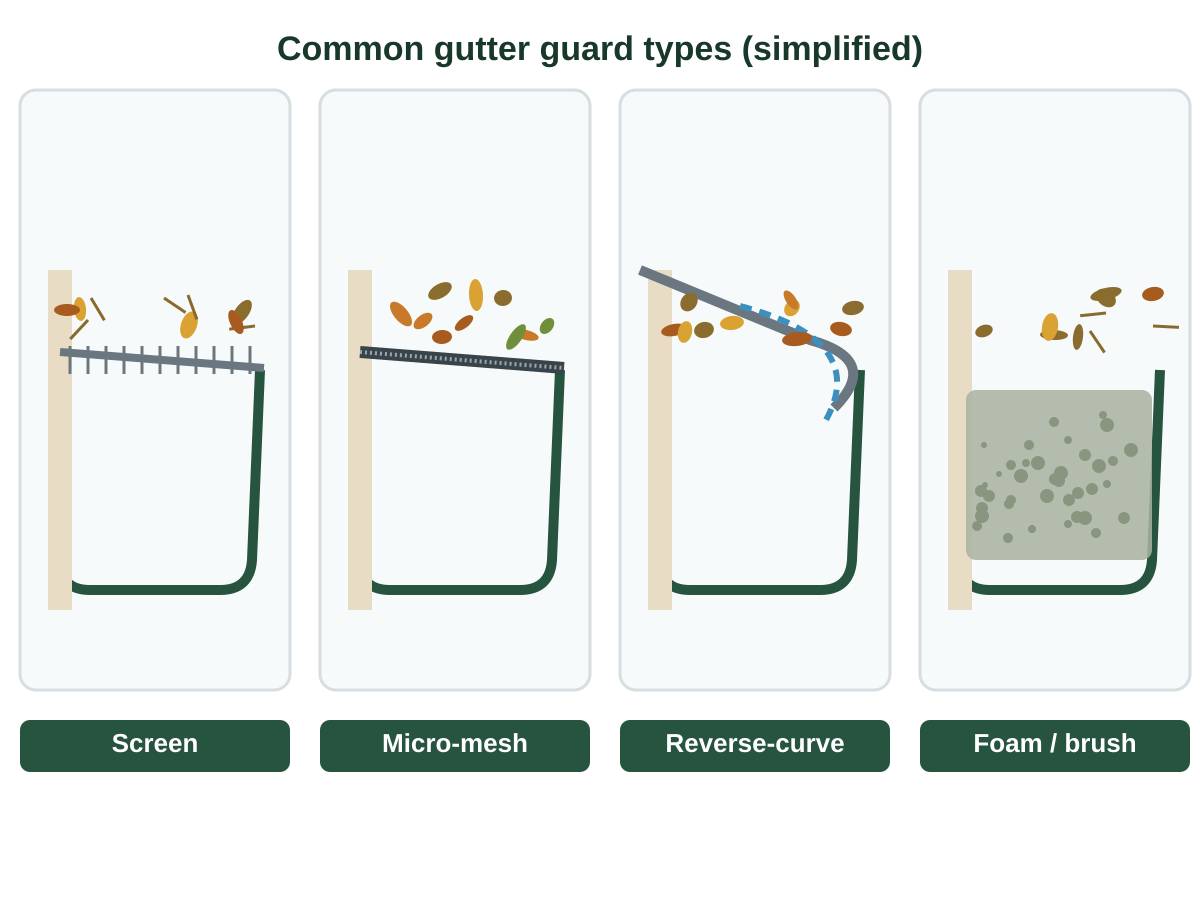
Rather than ranking brands, it helps to think about which family of guard suits what falls on your roof.
| Guard family | Broad leaves | Pine needles | Seed balls, tassels | Typical upkeep |
|---|---|---|---|---|
| Perforated screen | Good | Poor | Fair | Clear holes and gutter periodically |
| Fine micro-mesh | Very good | Good | Good (may sit on top) | Brush or rinse the surface |
| Solid hood / reverse curve | Good | Fair | Fair | Slot and hidden gutter still collect grit |
| Foam or brush insert | Fair | Poor | Poor | Pull out and clean; replace as it breaks down |
Screens and inserts are inexpensive and can be reasonable on a single-story home under a couple of maples. Solid hoods change the look of the roofline and can overshoot in the kind of heavy summer downpours Roswell gets. Fine mesh on a rigid frame is usually the most versatile choice for mixed pine and hardwood lots. For installed options, see our gutter guards service page.
What drives the price
We don't publish prices, because guard quotes vary widely with the home. The factors that move the number most:
- Total footage of gutter and the number of corners, miters and end caps.
- Height and pitch. A three-story downhill side over a walkout basement costs more to work on than a single-story eave.
- Guard family and material. Stainless micro-mesh on an aluminum frame costs more than a snap-in screen.
- Prep work. Cleaning, resealing, re-hanging or fascia repairs needed before the guards go on.
- Gutter size and style. Five-inch, six-inch, half-round and custom profiles each need compatible guards.
To judge value, compare the full installed quote against what you spend on cleanings now over the years you expect to stay, remembering that guards still need some upkeep. The cost guide covers what drives cleaning prices, so you can do that comparison with real numbers.
When to say no
A good professional will sometimes talk you out of guards. These are the situations where skipping them is usually the right call:
- Light tree cover. If one cleaning a year keeps things flowing, guards will take a very long time to pay for themselves.
- The gutters themselves are failing. Sagging runs, leaking seams, loose spikes or soft fascia need fixing first. Guards on a failing system just add weight and hide the damage. See gutter repair and fascia repair.
- Overflow in heavy rain even when clean. That points to undersized gutters or too few downspouts. Guards won't fix it; larger seamless gutters or added downspouts might.
- Pines overhead and only a cheap guard on offer. A screen or foam insert under pines often creates more work, not less.
- Historic or unusual gutters. Half-round, box or copper gutters on older homes may need specialized guards, and exterior changes in the historic district may need review. See historic Roswell gutters.
- You're selling soon. Buyers rarely pay extra for guards; clean, well-attached gutters matter more at inspection.
Before anyone installs anything
If you do go ahead, the prep matters as much as the product. Ask the installer to:
- Clean the gutters and flush every downspout, including any buried drain lines.
- Check the pitch and re-hang any sections that hold water.
- Replace loose spikes with hidden hangers and repair soft fascia.
- Seal leaking seams and corners.
- Explain how the guard attaches and whether it touches the shingles.
- Tell you, in writing, what upkeep the guards will need and how often.
It's also fair to ask for a cleaning-only price alongside the guard quote. Being able to compare the two is the whole point of this guide, and a straightforward professional won't mind.
Signs you're being oversold
- The recommendation comes before anyone looks at your trees or your gutters.
- You hear that you'll "never clean your gutters again."
- The price is only available if you sign on the spot.
- Nobody mentions the sag, the leak or the soft fascia you can see from the driveway.
The honest verdict
Guards are worth it in Roswell when heavy debris meets a roofline that's hard or risky to reach, the gutters are in good shape, and the guard is fine enough for what's falling, which usually means micro-mesh under pines. They're rarely worth it on lightly shaded, easy-to-reach homes, or on gutters that need repair. Whatever you choose, pair it with a sensible routine; our North Fulton gutter cleaning calendar shows when each tree does its damage.
Want a professional opinion on your home? Call (678) 820‑6633 or request a free estimate, and say whether you'd like a cleaning quote, a guard quote, or both. We'll connect you with an experienced, qualified local professional. More detail on installed options is on our gutter guards page.